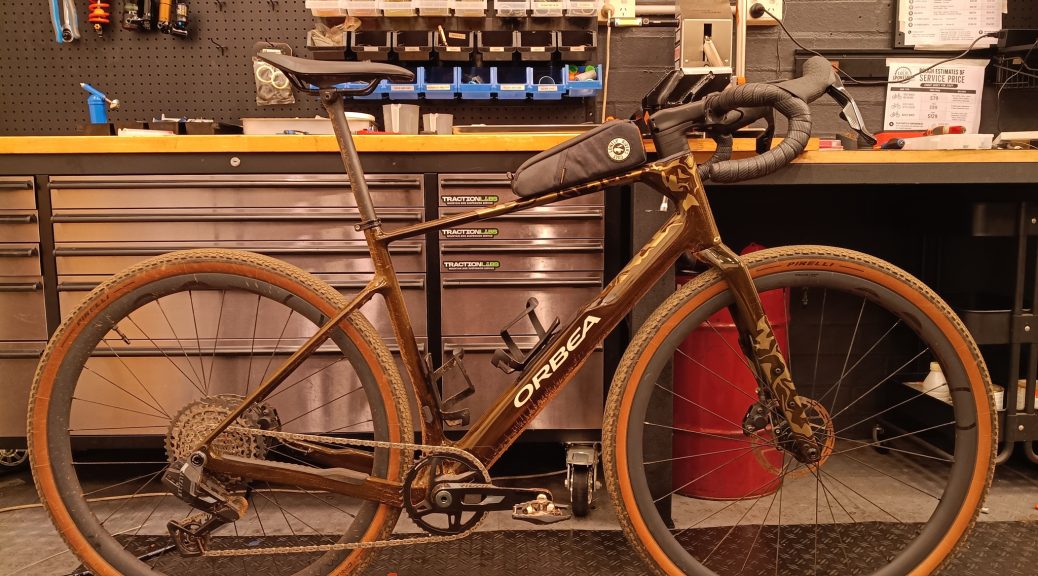
Reviewed: Orbea Terra
It finally happened. I’ve given in to the gravel urge. I’m only 10 years late….depending on who you ask and how you define the category. The lure of long, quiet stretches of wheatbelt or woodland roads, at much higher cruising speeds than my mountain bikes are capable of, is hard to resist.
Without romanticizing it too much, my love of bikes starts with engineering. I obsessively observe and appreciate fine engineering details that are hard to spot, and I’m even more interested in the design elements that aren’t visible at all. Carbon layups. Directional fibres. Suspension kinematics. Rider triangles. Tyre size and air volume. Wheels. Hub bearings. Crank Bearings… I could go on. I won’t.
I communicated directly with the Aussie imported for Orbea and chose the M30 eTeam in “Caramel Gloss over Carbon” – a stunning colour in the sun. Rival AXS 1×13 for drivetrain and brake duty, with Orbea in-house components for the post, bars and stem. The only real upgrade was the inclusion of OQUO RC30 Team Carbon wheels over the stock alloys. They aren’t quite as on trend as other brands in terms of being ultra wide or deep but they are definitely fit for purpose and look nice in a matte finish. The OQUO upgrade is worth the money, given the incremental cost versus purchasing another set elsewhere. I ditched the Vittoria Terreno tyres straight out of the box in favour of 45mm Pirelli Cinturato Gravel H tyres. Having a tan sidewall on a caramel/honey coloured bike was hard to resist. There is room to go bigger if I was doing some real adventuring, but 45mm at 28psi front and 30psi rear suits my intentions.
As a value proposition on paper……Orbea don’t appear to be very competitive. In my haste to get the bike ordered, I didn’t even realise it came specced with an alloy bar and stem. I simply assumed, based on everything else I cross-shopped it against, that everything at this price point was full carbon. There are other carbon frame + carbon wheel + Rival AXS specc’d bikes out there that retail for a thousand dollars (or more!)…. less. My complete bike came in at an RRP of $9,160. Full disclosure, I paid less than that given my industry connections, but I still paid upfront, with real money.
Once the box was open and I started building the bike I could actually see that the fit and finish on the carbon frame is LEAGUES ahead of other brands that offer similar builds for less money. It comes with perfectly applied frame protection on the top tube, downtube and stays. The decals under the clear coat all have crisp, perfect outlines. The clear coat itself is flawless. Someone with real skills painted this frame. The deliberate balance between stiffness and compliance in the carbon layup is a finely honed thing and becomes apparent once the bike is up to speed.
My first 4 rides took in a few different types of trail and conditions.
- A 65km Chidlow-Leschenaultia test
- A Bakers Hill pie shop run in the pouring rain
- Beyond Bakers Hill to get to Northam which was ultimately scuppered by bad navigation and poor planning
- A Bindoon-Julimar forest adventure with more climbing and descending than those first 3 rides combined.
These 4 rides add up to just over 400km on the Terra, and here is what I learned:
- The Terra is supremely comfortable. I think the excellent choice of Fizik saddle and compliant seatpost setup is mostly to thank.
- The new generation Rival AXS drivetrain and brakes are utterly, utterly brilliant in all conditions. Shifting. Pedalling. Stopping. How the hoods feel under tired palms. How light the brake levers are – they are exceptional.
- Stability at speed on flats or even gentle descents is fantastic, but the very tall front end stack height definitely gets in the way on proper gravel descents where speeds exceed 45kmh. I took 20mm worth of spacers out and cut the steerer to match, and haven’t looked back.
The Terra isn’t a race bike, though they do offer a race version now. It carries good speed across gravel and does a great job of filtering out the trail buzz. Orbea’s engineers point out that the round-to-square profile of the downtube where it meets the frame storage compartment helps dissipate vibration. Combined with the tall, skinny seat post with deliberate amounts of flex, the amount of comfort on offer is amazing. These, plus the tall front stack, the obvious lack of any real aero and the compliant frame layup all contribute to this bikes personality as a capable and versatile way of exploring trails away from the familiar MTB loops, at the expense of outright speed. This is a compliment, not a criticism. It does exactly what I want it to do.
The nice long chainstays offer surprising levels of traction when climbing, especially when doing cheeky laps of green rated MTB trails. My Julimar Forest adventure saw me hit pinches of 18 and 21% – I had rear tyre grip all the way up the point where I simply couldn’t turn the pedals anymore.
Downsides? Well…..very few. I find the in-frame storage “LOCKR” thing to be a bit flimsy. I also neatly taped up the bottom end of the locker plate to help prevent it scratching the small section if frame it rests against. The flimsiness of the storage lid means that a full water bottle on a rough trail is prone to ejection. As a general rule, I find that side-loading bottle cages don’t hold a bottle firmly enough on anything except champagne gravel. Secondarily, the actual locking mechanism itself is nothing more than a very short, stubby M3 thread connecting the lever to the locking cam underneath. It can and will come loose if not thread locked.
Now that I’ve got my stack height and tyre pressures dialled, I’m keen to do bigger days out than ever before – hopefully before summer arrives in full force….