

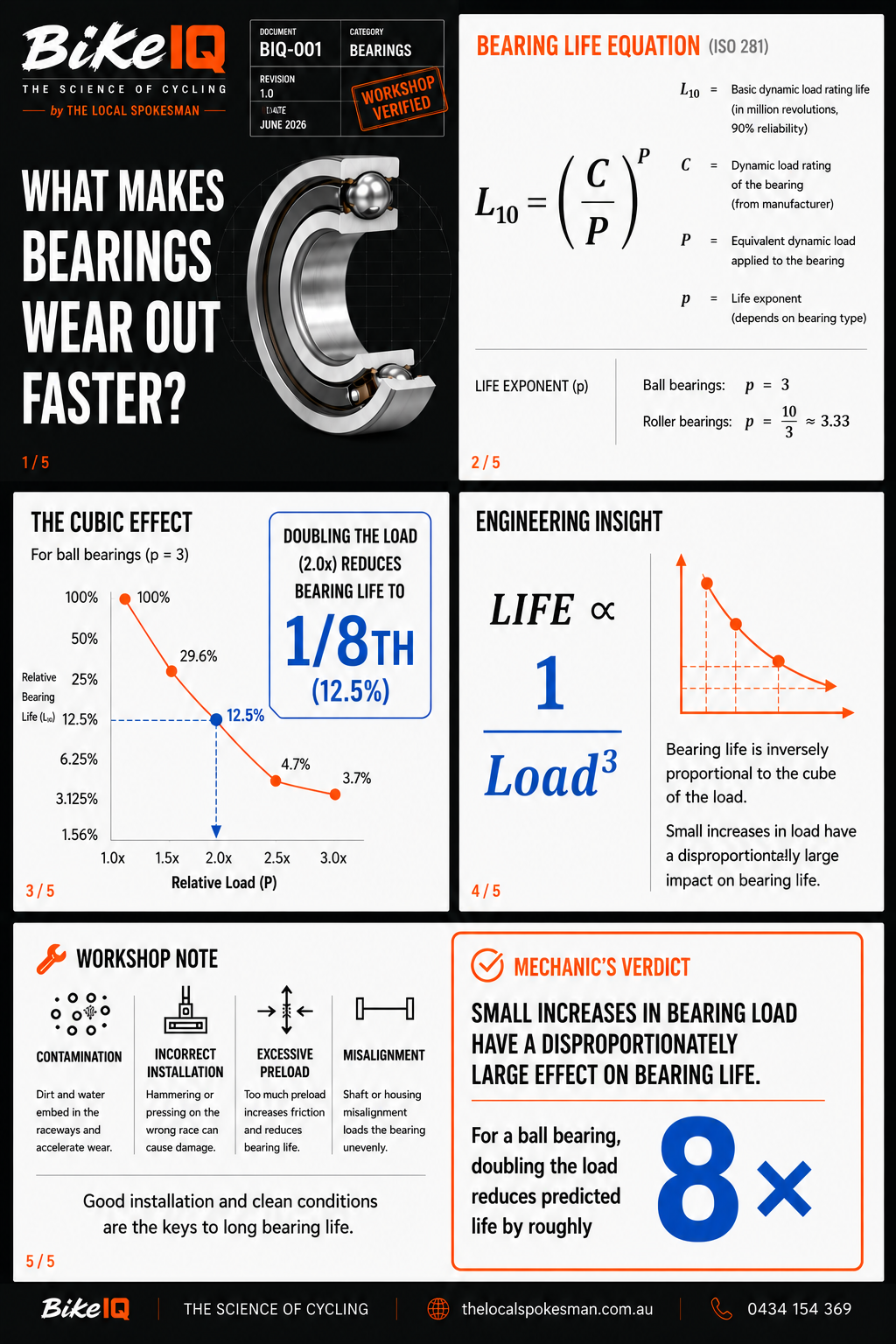
Bearing life is mostly governed by one brutal relationship: fatigue damage increases exponentially with load.
For ball bearings, lifespan is estimated with the L10 life equation. L10 is a statistical reliability metric, meaning that at a given number of revolutions no more than 10% of the batch will have failed.
The parts of the equation
- C = bearing dynamic capacity
- P = equivalent radial load
- p = life exponent. For ball bearings this is approximately 3, which makes the relationship cubic.
C is a fatigue rating determined under lab conditions. It is the theoretical constant load that bearing can handle for 1 million revolutions, with 90% reliability.
Why rider weight is not the whole story
P is trickier. It is not just the “weight” of the system carried by the bearing. It is a damage-equivalent abstraction derived from the loads acting on the bearing.
- Fr = radial force
- Fa = axial force
- X, Y = weighting factors based on bearing geometry
What bicycle wheel bearings actually deal with
For a bicycle bearing, the real-world loads include:
- Radial load — rider weight plus impacts
- Axial load — cornering loads and disc brake torque
- Shock loads — bumps, landings and repeated hits
- Misalignment loads — fork flex, axle deflection, hub or frame tolerance issues
- Crush load — manufacturing tolerance in the hub, or excessive interference fit
Workshop verdict
Heavy riders do not automatically wear wheel bearings out exactly twice as fast. The relationship is not linear.
But if the equivalent bearing load doubles, a ball bearing’s predicted fatigue life drops to roughly one eighth. Small increases in bearing load can have a disproportionately large effect on bearing life.
The practical takeaway
Clean conditions, correct installation, sensible preload and good alignment matter. Contamination, incorrect pressing, excessive preload and misalignment can all increase the effective load on the bearing — and once that load rises, bearing life falls fast.